
Chinese courts have issued a significant series of rulings stating that companies cannot legally dismiss employees solely on the grounds of replacing them with artificial intelligence systems, marking a notable development in how the law is beginning to respond to rapid workplace automation.
The decisions, delivered through multiple labor dispute cases in major cities including Beijing and Hangzhou, clarify that the introduction of AI technology does not automatically justify termination of employment contracts. Instead, employers are required to follow established labor procedures, demonstrate valid legal grounds for dismissal, and provide reasonable alternatives such as reassignment or retraining where possible.
The rulings come at a time when AI adoption is accelerating across China’s economy, particularly in sectors such as customer service, data processing, logistics, marketing, and administrative support. Many companies have been experimenting with automation tools to reduce costs and improve efficiency, often restructuring teams in the process. However, the courts have now drawn a clearer line between technological innovation and employment protection.
In one of the cases that contributed to the legal clarification, a technology company replaced a portion of its workforce with AI-driven systems designed to handle repetitive administrative tasks. An employee whose role was significantly reduced was offered a lower-paying position that he argued no longer matched his original job responsibilities. When he refused the new terms, the company terminated his contract. The court later ruled the dismissal unlawful, stating that the company had not followed proper procedures for modifying employment conditions and had failed to justify termination under labor law standards.
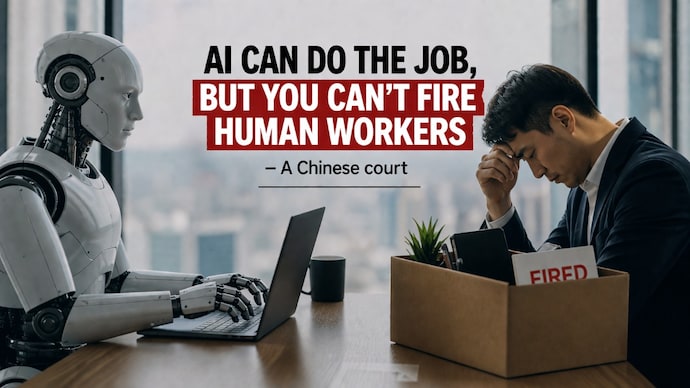
Judges emphasized that while companies are free to adopt new technologies, including AI systems, such decisions must not bypass the legal protections afforded to workers. The rulings made clear that automation, by itself, does not constitute “objective necessity” for firing employees. Employers must demonstrate that restructuring is unavoidable and that all reasonable alternatives have been considered before ending employment relationships.
In another case in Beijing, a dispute arose when an employer argued that AI integration had fundamentally changed the structure of its operations, making certain roles redundant. The company maintained that maintaining the same number of employees would undermine efficiency gains achieved through automation. However, the court rejected this reasoning as insufficient under existing labor regulations. It ruled that business efficiency improvements do not override contractual obligations unless proper legal procedures are followed, including consultation with employees and fair compensation where applicable.
Legal experts say these rulings reflect an effort by the judiciary to balance two competing priorities: encouraging technological advancement while ensuring job security and fair treatment for workers. As AI systems become more capable of performing tasks traditionally handled by humans, courts are increasingly being asked to interpret how existing labor laws apply in rapidly changing workplace environments.
One key principle highlighted in the rulings is that employment relationships cannot be altered unilaterally based on technological upgrades. If a company introduces AI that changes job functions, it must engage in good-faith negotiation with employees. This may include retraining workers for new roles, adjusting responsibilities with mutual agreement, or providing compensation if roles are eliminated under lawful redundancy procedures.
The courts also noted that improper use of AI as a justification for layoffs could lead to instability in labor markets and undermine worker confidence in technological transitions. Judges stressed that while innovation is encouraged, it must not come at the expense of legal rights or due process.
The rulings have sparked widespread discussion among employers, legal professionals, and workers across China. Many businesses are now reassessing their AI implementation strategies to ensure compliance with labor regulations. Some companies have begun investing more heavily in retraining programs, aiming to transition employees into new roles rather than eliminate positions outright.
Workers’ advocates have welcomed the decisions, viewing them as an important safeguard in an era of rapid automation. They argue that without clear legal boundaries, companies could use AI adoption as a justification for mass layoffs without accountability. At the same time, they acknowledge that the law must continue to evolve as technology reshapes the nature of work.
On the other hand, some business groups have expressed concern that strict interpretations of labor protections could slow down technological adoption or increase restructuring costs. They argue that companies need flexibility to adapt to global competition and rapidly changing markets, particularly in sectors where AI offers significant efficiency gains.
Despite these concerns, the rulings indicate that Chinese courts are taking a cautious approach to AI-driven workforce transformation. Rather than resisting automation itself, the legal system is focusing on ensuring that transitions are managed fairly and transparently.
Observers note that these cases may set an important precedent for future disputes involving AI and employment. As artificial intelligence becomes more integrated into workplace systems, similar legal questions are expected to arise in other jurisdictions as well.
For now, the message from the courts is clear: companies in China are free to innovate and deploy AI technologies, but they cannot bypass labor protections or dismiss employees solely because machines can perform their jobs. The human element of employment, at least under current legal interpretation, remains protected from being replaced without due process.