
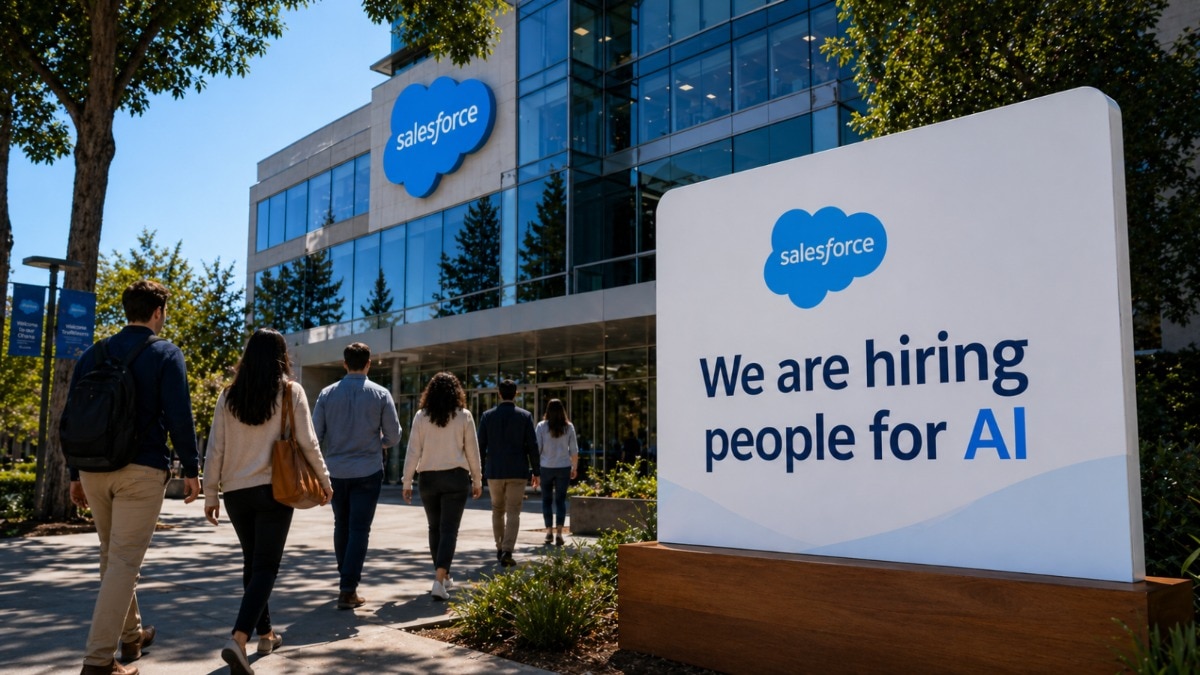
Salesforce has announced plans to hire 1,000 graduates and interns through its Futureforce program, expanding opportunities for young professionals as the company accelerates development of artificial intelligence products. The move highlights how major technology firms are continuing to invest in early-career talent despite ongoing concerns that AI could reduce entry-level employment opportunities.
The hiring initiative will focus on Salesforce’s growing portfolio of AI-driven tools, including Agentforce and Headless360, as the company works to strengthen its position in enterprise software and digital automation. New recruits are expected to join teams involved in engineering, product development, customer success, data operations, and business strategy, giving graduates and interns direct exposure to one of the most competitive areas in global technology.
Futureforce has long served as Salesforce’s flagship talent pipeline, helping students and recent graduates enter the company through internships, apprenticeships, and full-time positions. By placing AI at the center of the latest expansion, Salesforce is signaling that the future of work will depend not only on advanced software but also on people who can build, manage, and improve those systems.
The announcement comes during a period of intense debate about the impact of artificial intelligence on the labor market. Since the rise of generative AI tools, many economists and workers have questioned whether automation could replace junior employees in areas such as administration, customer service, marketing, coding, and analysis. Entry-level roles have often been viewed as the most vulnerable because they include repetitive tasks that can be automated.

However, Salesforce’s decision suggests that the relationship between AI and jobs may be more complex than early predictions implied. While automation may reduce the need for certain routine responsibilities, it is also creating demand for new kinds of roles. Companies still need employees to train AI systems, monitor outputs, ensure accuracy, improve user experiences, manage ethical risks, and integrate tools into everyday business operations.
For graduates, this means the first step into the workforce may look different than it did a decade ago, but opportunities still exist. Instead of performing only manual or repetitive work, younger hires may be expected to work alongside AI from the start of their careers. They may spend more time interpreting results, solving customer problems, collaborating across teams, and learning how technology can drive business growth.
Salesforce’s focus on Agentforce and Headless360 reflects two important trends shaping the technology sector. Agentforce is aimed at using AI-powered agents to automate tasks, assist employees, and improve productivity. Headless360 is linked to flexible digital systems that allow businesses to deliver personalized customer experiences across multiple platforms. Both areas are growing quickly as companies seek faster, smarter ways to engage clients and streamline operations.
The decision to recruit graduates and interns rather than relying solely on experienced professionals also carries strategic importance. Competition for skilled AI workers has intensified across the tech industry, with startups and established companies competing for a limited pool of senior engineers and researchers. By hiring early-career talent, Salesforce can train employees internally, build long-term loyalty, and create a workforce tailored to its own platforms and priorities.
For students entering the job market, the announcement may offer reassurance after several uncertain years. The technology industry has experienced layoffs, cost-cutting measures, and hiring freezes in parts of the sector. Many graduates feared that shrinking budgets and smarter automation tools would make it harder to secure first jobs. Salesforce’s latest hiring push suggests that companies are still willing to invest heavily in young talent when it aligns with future growth areas.
Industry experts say programs like Futureforce may become increasingly valuable. Traditional university education provides theory and foundational knowledge, but companies often need workers who can quickly adapt to changing tools and real-world business challenges. Internship and graduate programs help bridge that gap by giving recruits hands-on experience, mentorship, and exposure to enterprise-scale projects.
The initiative may also place pressure on other major employers to expand their own graduate pipelines. As competition for young talent grows, firms in software, finance, consulting, and e-commerce may need to offer clearer career pathways, better training, and stronger opportunities in emerging technologies. Graduates today are not just looking for a paycheck; many want meaningful work, flexibility, and skills that remain valuable in a rapidly changing economy.
For Salesforce, the recruitment drive is about more than filling vacancies. It is a statement that human talent remains essential even in an age of intelligent machines. AI may automate tasks, but businesses still depend on people to imagine new products, build trust with customers, and make strategic decisions.
The 1,000 new hires entering Futureforce could help shape the next chapter of Salesforce’s AI ambitions while launching their own careers in one of the world’s most influential technology companies. At a time when fears of job displacement remain widespread, the company is sending a different message: the AI era can create opportunity as well as disruption.
As the labor market evolves, graduates who combine technical skills, adaptability, and creativity may find themselves in greater demand than ever before. Salesforce’s latest move suggests the future workforce will not be defined by humans versus AI, but by humans working with AI.