Elon Musk’s artificial intelligence chatbot Grok has officially arrived on Apple CarPlay, marking another major step in the growing integration of AI assistants into everyday driving experiences. The update allows users to access Grok directly through their vehicle’s infotainment system, enabling hands-free conversations, information requests, and productivity support while commuting.
The move highlights how rapidly artificial intelligence is expanding beyond smartphones and computers into connected vehicles. As automakers and technology companies compete to redefine the in-car experience, Grok’s arrival on Apple CarPlay positions the chatbot as a new kind of digital driving companion designed to make commuting more interactive and conversational.
Developed by Musk’s AI company xAI, Grok was initially launched as an AI assistant integrated with X, formerly Twitter. Over time, the chatbot has evolved into a standalone AI platform with broader capabilities including real-time conversation, brainstorming assistance, information retrieval, and content generation. The CarPlay integration now extends those capabilities into vehicles, giving drivers access to conversational AI during everyday travel.
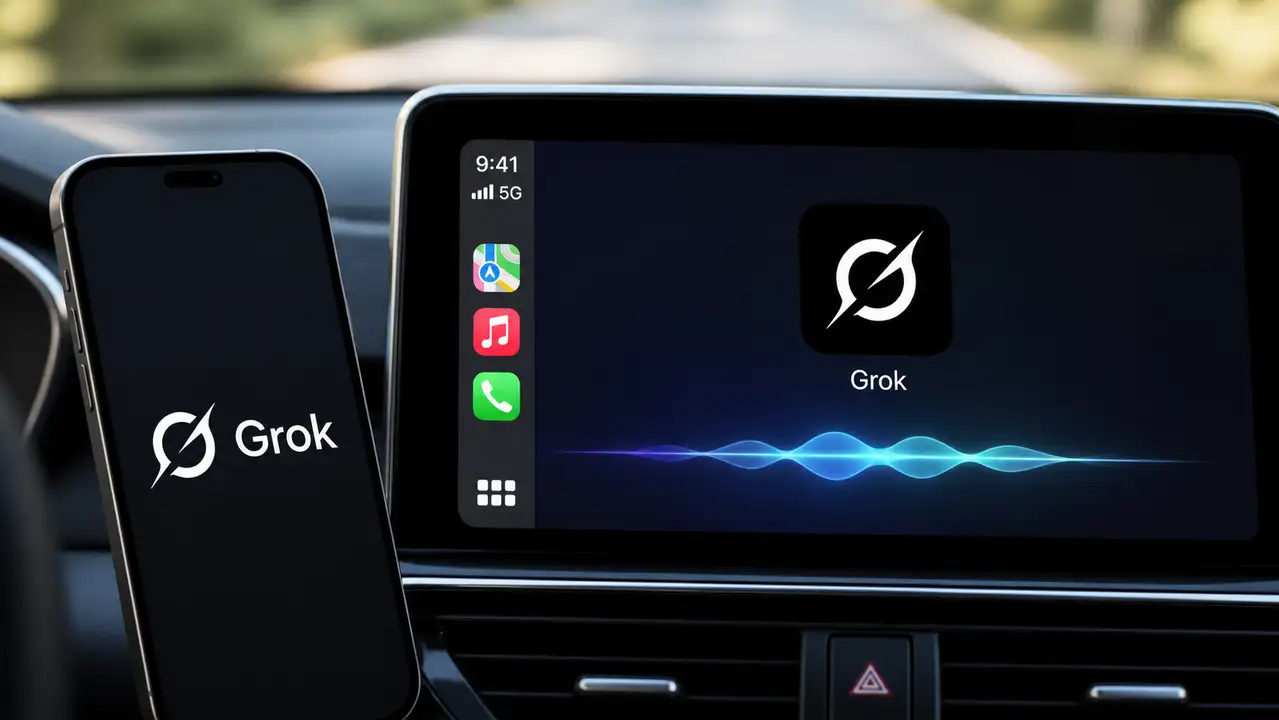
The feature works through the Grok mobile application on iPhones. Users first need to update the app to the latest version available through Apple’s App Store. Once installed, the app becomes compatible with Apple CarPlay-enabled vehicles when the iPhone is connected either wirelessly or through a USB connection, depending on the vehicle model.
After connection, the Grok icon appears within the CarPlay dashboard interface alongside other supported applications. Drivers can launch the assistant directly from the touchscreen display or activate it using voice controls built into CarPlay. In many vehicles, users can simply press the steering-wheel voice command button to begin interacting with the chatbot.
The system is designed primarily for voice-first interactions to reduce distraction while driving. Instead of requiring users to type or navigate complicated menus, Grok responds to spoken prompts through the car’s speakers in real time. Drivers can ask questions, request directions, get summaries of news updates, check weather conditions, or even brainstorm ideas while keeping their hands on the wheel.
One of the key differences between Grok and traditional in-car voice assistants is its conversational ability. Standard vehicle assistants often rely on rigid command structures, meaning users must phrase requests in a specific way. Grok, however, is designed to support more natural dialogue. Drivers can ask follow-up questions, clarify requests, or continue conversations without restarting commands.
For example, a commuter could ask Grok about traffic conditions, follow up with questions about alternate routes, and then request nearby coffee shops — all within the same conversation flow. The assistant can also help users draft short messages, summarize emails, explain concepts, or answer general knowledge questions during long drives.
The interface itself has been simplified for safety purposes. CarPlay displays only essential controls and minimizes on-screen text to avoid distracting drivers. Most responses are delivered through audio rather than visual elements, aligning with broader automotive safety standards that discourage prolonged screen interaction while driving.
The launch comes amid a wider industry push toward AI-powered vehicles and “digital copilots.” Automakers increasingly see cars not just as transportation devices but as connected smart environments capable of offering entertainment, productivity, and personalized assistance. Companies across the automotive and technology sectors are racing to integrate large language models and generative AI into infotainment systems.
Several automakers have already introduced AI-powered assistants that can adjust cabin settings, explain dashboard alerts, recommend charging stations for electric vehicles, or assist with navigation planning. Grok’s CarPlay integration reflects the next phase of this trend, where conversational AI becomes a central part of the driving experience.
The update may prove particularly attractive for Tesla owners who use iPhones, although the feature is not exclusive to Tesla vehicles. Any car that supports Apple CarPlay can potentially use the Grok integration, broadening its reach across multiple automotive brands.
Industry analysts believe the integration could help xAI strengthen Grok’s position in the increasingly crowded AI assistant market. The chatbot now competes not only with OpenAI’s ChatGPT and Google Gemini on smartphones and computers, but also with Siri, Alexa, and Google Assistant within vehicles.
At the same time, the expansion raises important questions around driver safety and AI reliability. Experts have long warned that conversational AI systems could potentially become distracting if interactions become too emotionally engaging or cognitively demanding while driving. Regulators and automotive safety organizations continue to monitor how advanced AI systems are implemented in vehicles.
To address these concerns, Grok’s CarPlay integration appears focused on short-form voice interactions rather than visually intensive experiences. The assistant currently does not control vehicle functions such as steering, braking, or acceleration. Instead, it operates as an infotainment and conversational layer on top of Apple CarPlay.
Privacy concerns may also emerge as AI systems gain access to more user interactions and driving-related contexts. Voice assistants typically process spoken requests through cloud-based servers, leading to ongoing debates about data handling, personalization, and user consent. Neither Apple nor xAI has indicated that Grok directly accesses sensitive vehicle-driving systems through CarPlay integration.
Despite these concerns, early reactions from users have been largely driven by curiosity and excitement. Many see the update as a glimpse into the future of connected transportation, where AI assistants become as common in cars as navigation systems or music streaming apps.

The introduction of Grok to Apple CarPlay demonstrates how quickly artificial intelligence is becoming embedded in daily routines. What began as a chatbot for online conversations is now evolving into a mobile companion capable of traveling with users throughout their day.
As AI technology continues to advance, the line between digital assistants and everyday environments is becoming increasingly blurred. With Grok now available inside vehicles through Apple CarPlay, the future of commuting may involve far more than listening to music or checking maps — it could become a fully conversational AI-powered experience.