In a groundbreaking move to enhance passenger experience, Google has rolled out an innovative augmented reality (AR) feature aimed at assisting lost travelers at Sydney Airport. This cutting-edge technology promises to revolutionize the way people navigate through bustling airports, providing a seamless solution for those who find themselves disoriented in the complex maze of terminals.
The new AR feature, integrated into the Google Maps app, is designed to guide passengers step by step to their desired destinations within the airport. Whether it’s locating a specific gate, airline counter, or even the nearest restroom, users can rely on the augmented reality overlay to visualize directions in real-time through their smartphone cameras.
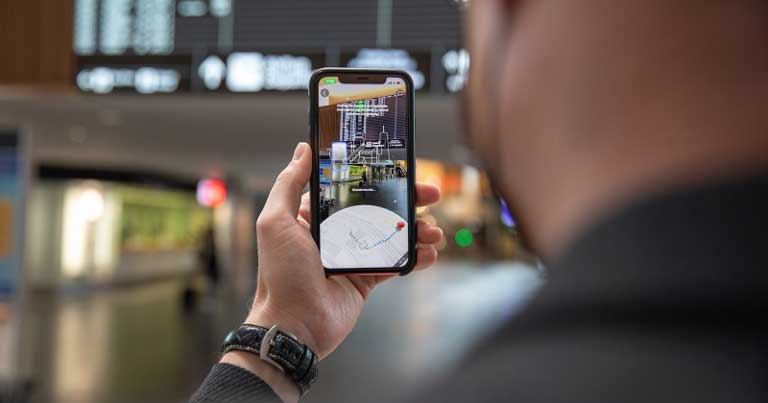
Sydney Airport, being one of the busiest international hubs in the Asia-Pacific region, has often presented a challenge for travelers to navigate efficiently. The introduction of Google’s AR feature aims to address this issue by offering a user-friendly and interactive solution.
Passengers can simply open the Google Maps app on their smartphones, select Sydney Airport as their destination, and enable the augmented reality feature. The app will then utilize the device’s camera to overlay directional arrows, labels, and other navigational cues directly onto the live view of the airport environment. This makes it easier for users to follow a path to their intended location without the need for additional paper maps or assistance from airport staff.
Google’s move into augmented reality navigation is part of a broader trend in leveraging technology to enhance travel experiences. With the increasing reliance on smartphones and mobile apps, integrating AR into navigation tools is seen as a natural progression to make the travel process smoother and more user-friendly.

The Sydney Airport authorities have welcomed this initiative, recognizing the potential benefits it brings to both domestic and international travelers. The AR feature is not only expected to reduce the stress and frustration associated with navigating the expansive airport but also contribute to overall passenger satisfaction.
As technology continues to play a pivotal role in shaping the future of travel, Google’s augmented reality feature at Sydney Airport sets a new standard for navigation assistance. This development hints at a future where AR could become a common tool for wayfinding in various public spaces, transforming the way people navigate and interact with their surroundings.