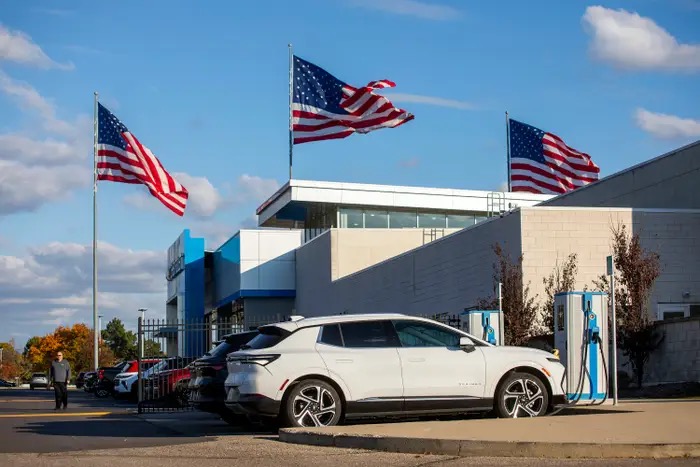
General Motors has announced it will take a $6 billion writedown linked to a pullback in its electric vehicle (EV) strategy, marking one of the most significant financial acknowledgments yet of the challenges facing the global EV transition. The charge reflects a combination of cash and non-cash costs associated with slowing EV production, renegotiating supplier contracts, and reassessing long-term investments made during a period of far more optimistic demand forecasts.
The writedown will be recorded in GM’s latest quarterly results and stems from what the company describes as a “strategic recalibration” rather than a retreat from electrification. Still, the size of the charge underscores how sharply market conditions have shifted since automakers raced to invest tens of billions of dollars in EV factories, battery plants, and supply chains earlier in the decade.
GM executives said the decision was driven by weaker-than-expected EV demand in North America, rising costs, and increasing uncertainty around regulatory and policy support. While EV sales continue to grow overall, the pace has slowed significantly, especially in the mass-market segment where affordability remains a major barrier for consumers.
A large portion of the writedown relates to cash costs tied to supplier settlements and the cancellation or modification of long-term contracts that were signed when GM anticipated much higher EV volumes. The remainder consists of non-cash impairments on assets such as underutilized manufacturing capacity, tooling, and equipment dedicated to EV production that will no longer be needed at previously planned levels.
The automaker has already delayed or scaled back several EV-related projects, including adjustments to output targets at key assembly plants. GM had once outlined aggressive goals to rapidly expand its electric lineup and reach profitability in its EV business within the decade. Those timelines have now been extended as the company shifts its focus toward balancing electrification with continued demand for gasoline-powered vehicles and hybrids.
Industry analysts note that GM’s move reflects broader trends across the global auto sector. Many traditional automakers are reassessing EV investment plans after years of heavy spending produced thinner margins and slower returns than expected. High interest rates have dampened consumer appetite for big-ticket purchases, while persistent concerns about charging infrastructure, battery range, and resale values have limited EV adoption beyond early adopters.
Policy uncertainty has also played a role. Changes in government incentives and emissions rules have made long-term planning more difficult for automakers. EV tax credits that once supported demand have become more restrictive or less predictable, while debates over future fuel economy and emissions standards have created additional complexity for companies trying to allocate capital efficiently.
Despite the writedown, GM emphasized that electric vehicles remain a core part of its long-term strategy. The company said it will continue to offer its existing EV models across its Chevrolet, GMC, and Cadillac brands, while prioritizing those segments where demand is strongest, such as premium vehicles and commercial fleets. GM also reiterated its commitment to battery technology development, calling it a critical competitive advantage over the long run.
At the same time, the company is increasingly leaning on hybrid vehicles as a transitional solution. Hybrids, which combine internal combustion engines with electric drivetrains, have gained popularity as consumers look for improved fuel efficiency without the range anxiety or charging challenges associated with fully electric cars. GM has signaled it will expand hybrid offerings across several models, reflecting a more flexible approach to electrification.
The $6 billion charge will weigh heavily on reported earnings, but GM said it does not change its underlying financial strength. Excluding one-time items, the company expects its core automotive business to remain profitable, supported by strong sales of trucks, SUVs, and other high-margin vehicles. GM also continues to generate significant cash flow, which it says provides the flexibility needed to navigate an uncertain market environment.
Investors reacted cautiously to the announcement, viewing the writedown as both a negative headline and a realistic acknowledgment of market conditions. Some analysts welcomed the move as a necessary reset that clears the deck for more disciplined capital allocation going forward, even as others warned that further EV-related charges could follow if demand remains sluggish.
GM’s decision highlights a growing divide between early expectations and current realities in the EV market. While electrification is widely seen as inevitable over the long term, the path forward appears far less linear than automakers once assumed. Instead of a rapid, across-the-board transition, the industry now seems headed toward a more gradual and uneven shift, shaped by consumer behavior, economics, and policy choices.
For GM, the writedown marks a sobering moment in its electric journey. It reflects both the cost of moving too quickly in a still-evolving market and the difficulty of reversing course once massive investments have been made. As the company recalibrates its strategy, the focus will be on balancing ambition with pragmatism—pursuing electrification, but at a pace the market is willing to support.