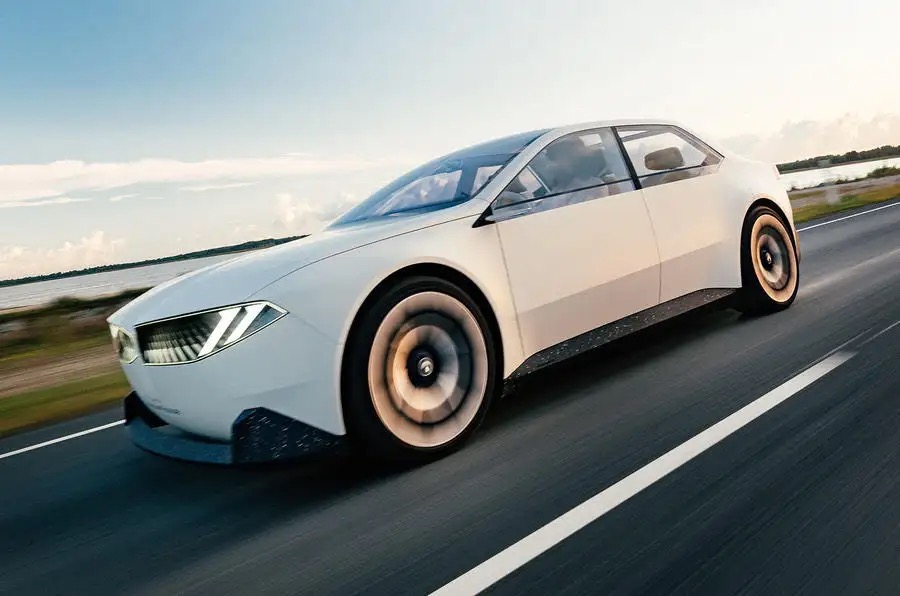
BMW has confirmed a major strategic shift for one of its most iconic performance cars, revealing that the next-generation BMW M3 will be offered in both fully electric and internal combustion engine (ICE) variants, with both models expected to sit in a similar price range. The announcement signals a rare approach in the automotive industry, where radically different technologies will coexist not only in spirit, but also in cost positioning.
The German automaker also indicated that the upcoming high-performance electric version—capable of producing around 1000 horsepower—will be priced “in the same ballpark” as its petrol-powered counterpart. The move reflects BMW’s effort to position electrification not as a premium alternative or a downgraded replacement, but as an equal performance path.
At the centre of this strategy is the idea of offering buyers genuine “choice” between two distinct interpretations of the same legendary performance badge. One version of the M3 will preserve the mechanical character and engine-driven emotion associated with traditional combustion performance cars. The other will deliver extreme electric performance defined by instant torque, advanced software control, and near-silent acceleration.
A split identity for a single performance icon
BMW’s decision effectively ensures that the M3 nameplate will not transition into a purely electric future, at least not in the immediate generation cycle. Instead, it will evolve into a dual-platform model line where both electric and combustion versions are developed in parallel.

The electric variant is expected to be the most radical. Early development details suggest a quad-motor configuration, with one electric motor powering each wheel. This setup is expected to deliver close to 1000bhp, placing the car firmly in supercar territory in terms of performance. Beyond raw power, the system will allow for highly advanced torque vectoring, enabling precise control over each wheel’s output in real time.
This level of control is expected to significantly enhance handling, especially in high-speed cornering situations. Unlike traditional drivetrains that rely on mechanical differentials, the EV system can adjust power distribution instantly through software, potentially offering a new dimension of agility.
Meanwhile, the petrol-powered version of the M3 will continue to evolve rather than disappear. It is expected to build on BMW’s latest inline-six engine architecture, likely incorporating mild-hybrid or plug-in hybrid assistance to meet tightening global emissions regulations. Despite these changes, BMW is expected to preserve the core driving characteristics that have defined the M3 for decades, including its engine responsiveness and mechanical feel.
Pricing strategy challenges convention
Perhaps the most surprising element of BMW’s announcement is its pricing philosophy. Traditionally, electric performance cars have been positioned either above combustion models due to high battery and software development costs, or below them to encourage adoption. BMW’s decision to align pricing across both versions breaks with this pattern.
By placing the EV and ICE M3 in the same price bracket, BMW is effectively removing cost as a deciding factor for buyers. Instead, the choice will be based on driving preference, emotional connection, and desired experience rather than financial advantage.
This strategy reflects the growing complexity of performance car development. While electric vehicles require expensive battery systems, cooling solutions, and high-output electric drivetrains, combustion vehicles are also becoming increasingly costly due to emissions compliance, hybrid integration, and advanced engineering required to meet modern efficiency standards.
BMW appears to be balancing these rising costs across both platforms, rather than allowing one to dominate pricing structure.
Engineering ambition behind the EV M3
The electric M3 is expected to represent one of the most technologically advanced vehicles BMW has ever produced. The quad-motor system is not only about delivering extreme power, but also about redefining how performance cars behave dynamically.
With individual motors controlling each wheel, engineers can fine-tune handling characteristics in ways that were previously impossible. The system can theoretically adjust traction, stability, and cornering response hundreds of times per second, creating a highly adaptive driving experience.
Acceleration is expected to be ferocious, with estimates suggesting the EV M3 could reach 0–100 km/h in under three seconds. However, BMW has emphasised that the goal is not simply straight-line speed. Instead, the focus is on creating a car that feels engaging and responsive in a wide range of driving conditions, including everyday road use and track environments.
Battery placement will also play a critical role. The pack is expected to be integrated into the floor of the vehicle, lowering the centre of gravity and improving weight distribution. This layout is essential for maintaining balance and agility, especially in a high-powered sedan format.
Thermal management systems are also expected to be significantly more advanced than those found in current BMW EVs. Sustained performance under repeated hard driving is a known challenge for electric performance vehicles, and BMW is reportedly investing heavily in cooling technology to address this.
The ICE M3 remains a cornerstone
Despite the strong focus on electrification, BMW has made clear that the combustion-powered M3 remains a core part of its identity. The next-generation ICE model is expected to continue offering a six-cylinder engine, maintaining continuity with the car’s long-standing heritage.
While electrification pressures will likely introduce hybridisation, BMW is expected to prioritise preserving the emotional and mechanical qualities that enthusiasts associate with the M3 name. This includes engine sound, throttle response, and the tactile feedback that has traditionally defined performance driving.
The decision to retain both powertrains reflects differing global market conditions. While some regions are rapidly moving toward electric mobility, others still rely heavily on combustion engines due to infrastructure limitations and consumer preferences. BMW’s dual approach allows it to remain competitive across both environments.

A broader shift in performance philosophy
BMW’s announcement reflects a broader shift in how performance cars are being defined. Rather than replacing combustion with electric power outright, the company is positioning both as valid expressions of the same performance philosophy.
The message is clear: the future of the M3 is not singular, but dual. One path preserves tradition and mechanical engagement. The other embraces electrification and digital control. Both are being developed with equal importance and, notably, similar pricing.
As the automotive industry moves deeper into the electrification era, BMW’s approach suggests that transition does not have to mean replacement. Instead, it can mean coexistence—at least for now.