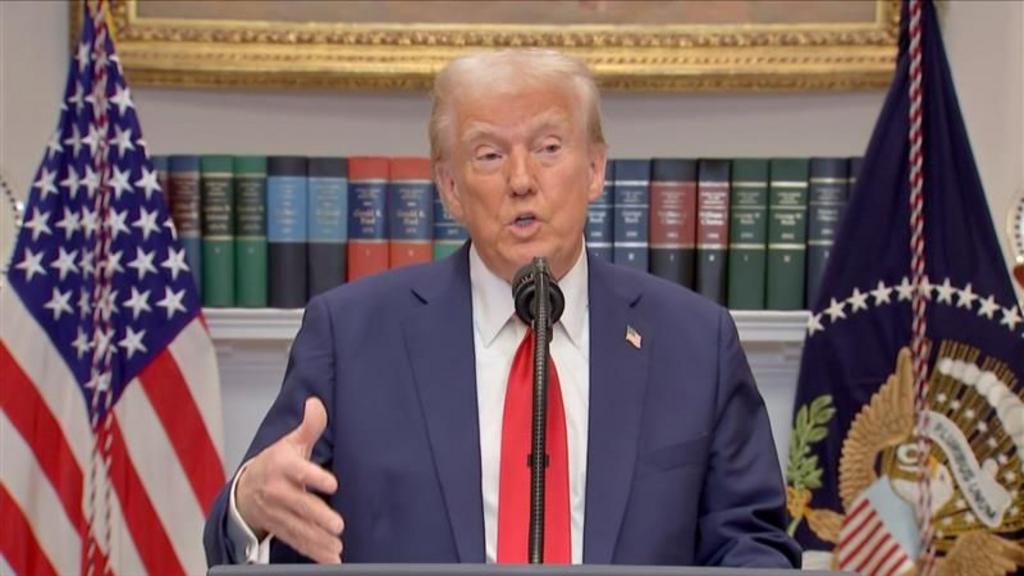
Donald Trump has never been a man of small ambitions—and now, the former president claims to have secured what he calls a “10% stake” in the American economy, a bold declaration that has sparked both celebration and alarm across the political and financial spectrum.
The number isn’t literal, of course. No individual can own a portion of a sovereign nation. But Trump’s latest statement reflects the scope of his ever-growing empire, which now spans media, real estate, technology, retail, political fundraising, and entertainment. Whether by assets, influence, or revenue, Trump’s grip on the American system is tighter than ever—and by his own estimate, strong enough to rival major corporations and entire political parties.
“I built it. I expanded it. Now we run it,” Trump said during a rally in Florida last week. “They laughed when I said we’d take our country back. But look around—we own the future now.”
The Trump Empire Reborn
Since leaving office in January 2021, Donald Trump has embarked on a mission to rebuild and expand his influence—economically, culturally, and politically. No longer constrained by the duties of the presidency, Trump has fully embraced his role as a businessman, media mogul, and kingmaker.
His flagship media venture, Truth Social, now ranks among the most used social platforms in America, boasting tens of millions of active users and serving as the primary communication tool for conservative voices nationwide. Its success has been fueled by exclusive interviews, live event streams, and a dedicated e-commerce platform featuring Trump-branded merchandise, collectibles, and premium memberships.
On the business front, the Trump Organization has not only recovered from earlier legal battles—it has grown. New luxury resorts have opened in Texas, Florida, and Nevada. Branded residential developments and office spaces have sprung up in several conservative-leaning states, heavily marketed to “patriotic investors” seeking to live or work under the Trump brand.
Meanwhile, Trump Ventures—a holding company quietly formed in 2023—has acquired interests in manufacturing, digital banking, media production, and even energy infrastructure. With this expansion, Trump’s presence has extended well beyond hotels and golf courses. He now claims direct or indirect ties to companies responsible for everything from producing smart TVs to processing online payments.
The Political Business Model
What sets Trump apart from other wealthy entrepreneurs is how deeply intertwined his financial empire is with his political movement. Every rally doubles as a product launch. Every merchandise purchase becomes both a political statement and a source of revenue. Every campaign event functions as both a fundraising operation and a brand experience.
Trump’s political action committees have raised billions of dollars since 2021, most of which has been funneled into supporting loyal candidates, sponsoring conservative events, and reinforcing his media platforms. His ability to dominate the narrative within the Republican Party remains uncontested.
Candidates continue to seek his endorsement, often adjusting their messaging or policies to align with his agenda. His influence extends down the ballot, impacting local school boards, state legislatures, and governor’s races. In effect, Trump’s political machine behaves like a corporation, with brand loyalty driving customer behavior—in this case, voter turnout and donations.
The 10% Claim
So what does Trump mean by saying he owns 10% of the U.S. economy?
According to his inner circle, the number reflects the combined value and influence of his ventures—not just revenue or holdings, but his reach across consumer markets, media consumption, and political fundraising.
Between media platforms, licensing deals, retail sales, campaign funds, and property assets, Trump reportedly commands hundreds of billions of dollars in market activity. Add to that the loyal customer base—tens of millions who regularly buy, share, donate, or vote in alignment with his messaging—and his team argues that the 10% figure is not far-fetched.
Critics, of course, call the number inflated. But Trump supporters say it’s less about raw numbers and more about symbolic control. Trump, they argue, has created an alternative ecosystem within America: one with its own news, commerce, leaders, and values.
“He’s not just in the economy—he’s reshaping it,” one supporter at a recent rally explained. “We buy American. We buy Trump.”
Looking Ahead
With the 2026 midterm elections on the horizon, Trump is positioning himself not just as a political leader but as a national brand. His rallies are bigger. His media machine is louder. His business ventures are expanding across both physical and digital landscapes.

Rumors continue to swirl about another presidential run in 2028, though Trump has remained noncommittal. For now, he seems content to wield influence from the outside—unbound by the rules of office, free to operate as both CEO and political icon.
“If I wanted to run again, we’d win,” he told a crowd in Ohio earlier this month. “But why rush? We’re already running everything from the outside.”
Whether the “10%” figure holds up to economic scrutiny or not, one thing is certain: Donald Trump’s hold on American life—through money, media, and message—is far from over.