In a groundbreaking move that could reshape the future of computing and global communications, IBM and Cisco have announced a long-term partnership aimed at building the foundational infrastructure for a quantum internet. The initiative focuses on creating a distributed quantum computing network that connects fault-tolerant quantum systems across long distances — a technical vision that, if achieved, would mark one of the most significant leaps in information technology since the birth of the classical internet.
The collaboration brings together IBM’s leadership in quantum hardware and software and Cisco’s vast experience in networking technologies. Their shared goal is to develop architectures, protocols, and technologies capable of transmitting and synchronizing quantum information between geographically separated quantum processors. Unlike today’s classical networks, which exchange bits, a quantum internet would allow the transfer of qubits and entangled quantum states, enabling computation and communication models that are fundamentally impossible with traditional infrastructure.
A New Era: Distributed Quantum Computing
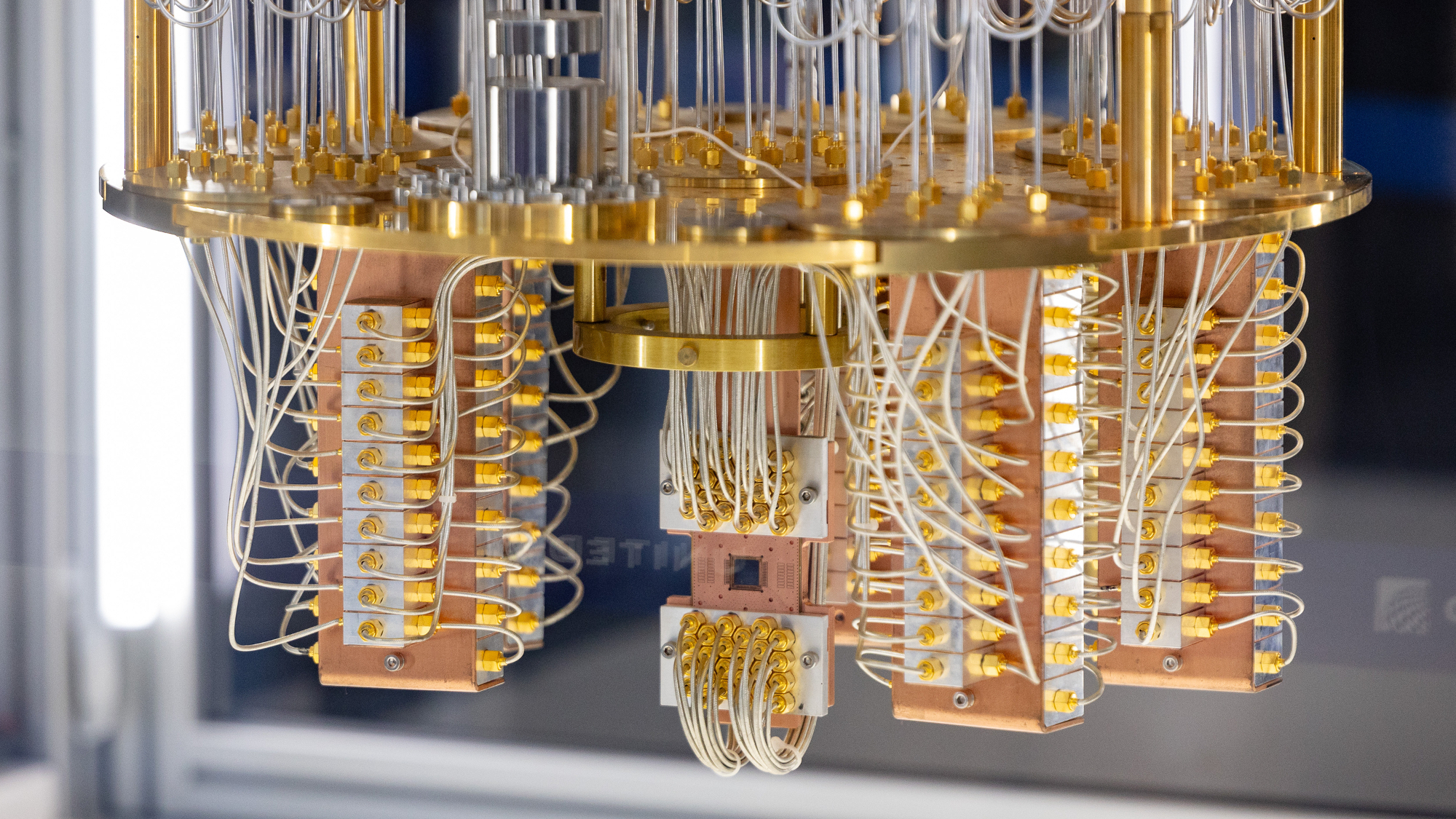
At the center of the partnership is the concept of distributed quantum computing. Today’s quantum processors are powerful but constrained — limited by the number of qubits that can be reliably maintained on a single chip and by challenges associated with error rates and decoherence. A distributed model aims to connect multiple fault-tolerant quantum computers, effectively pooling their resources. Instead of relying on one massive quantum processor, the network would allow multiple smaller but stable systems to work together as if they were a single, unified machine.
This approach takes inspiration from classical distributed computing, but adapting the idea to quantum environments is significantly more complex. Quantum states cannot be copied, and they are extraordinarily fragile. Even tiny disturbances — vibration, temperature fluctuations, electromagnetic interference — can corrupt data. Connecting quantum machines across cities or even across different sections of a data center requires solving challenges that have stumped researchers for decades.

IBM and Cisco believe that recent advancements in error correction, cryogenic systems, optical networking, and quantum transduction have opened a window of opportunity. Their partnership is designed to accelerate progress in these areas and produce a working model within the next decade.
How a Quantum Internet Would Work
The proposed architecture involves pairing each quantum computer with a quantum networking unit capable of translating the processor’s internal qubits into “flying” qubits that can travel over fiber-optic cables. These flying qubits—often encoded as photons—can carry quantum information across long distances, provided the transmission system minimizes loss and preserves the qubits’ delicate quantum states.
To support this, the companies envision several layers of new networking technology:
- Quantum Transducers: Devices that convert signals from microwave qubits (used inside quantum processors) to optical qubits suitable for long-distance travel.
- Quantum Repeaters: Infrastructure capable of extending the range of quantum communication by refreshing and extending entangled states without collapsing them.
- A Quantum Networking Stack: The software and protocol layers needed for routing, error correction, synchronization, entanglement distribution, and resource allocation.
- Fault-Tolerant Quantum Nodes: Advanced quantum computers built to detect and correct errors, ensuring reliable performance even when linked to remote systems.
Together, these components form the backbone of what IBM and Cisco call a “quantum computing internet” — a network that can move quantum information between machines with minimal disruption, enabling large-scale, collaborative computation.
Why Fault Tolerance Is Crucial
A defining feature of this initiative is the companies’ emphasis on fault-tolerant quantum systems. Current early-stage quantum processors are noisy and prone to error, and while they show promise, they cannot support the sustained, long-distance operations required for a distributed network. Fault-tolerant systems, on the other hand, use layers of quantum error-correcting codes that allow computations to continue even when errors occur.
Fault tolerance is not merely a performance enhancement — it is a prerequisite for quantum networking. Without reliable qubits that can survive long enough to travel, synchronize, and entangle across distances, a quantum internet would be impossible. IBM and Cisco’s plan relies on the assumption that fault-tolerant devices will reach maturity within the next several years, allowing them to serve as the foundation of the network.
Potential Applications and Impact
A functioning quantum internet would unlock new possibilities in fields that demand computational power beyond the capabilities of classical supercomputers. Distributed quantum computing could dramatically accelerate breakthroughs in:
- Drug discovery and molecular simulation
- Cryptanalysis and post-quantum security research
- Climate modeling and energy optimization
- Material science and superconductivity research
- Artificial intelligence and complex system analysis
Perhaps most revolutionary is the prospect of unhackable communication. Quantum networks could implement quantum key distribution (QKD) and advanced cryptographic techniques that prevent eavesdropping by exploiting the fundamental laws of physics. Any attempt to intercept quantum information would disturb it, alerting users to a breach immediately.
Governments, financial institutions, research organizations, and technology companies worldwide have been exploring quantum networking for years. This new IBM–Cisco collaboration could provide the industrial-scale push needed to transform prototypes into global infrastructure.
Timeline and Future Outlook
While the companies emphasize that the project will unfold over many years, they have outlined a phased strategy. Initial work will focus on building the hardware and developing the first versions of the quantum networking software stack. The next phase will involve linking systems within the same facility, followed by inter-facility experiments over metropolitan distances. Ultimately, the goal is a full-scale, multi-node, long-distance network of fault-tolerant quantum computers.
If successful, the IBM-Cisco initiative could mark the beginning of a new technological epoch — one where distributed quantum computing becomes as ubiquitous as cloud computing is today. A quantum internet would be transformative not just for industry and research but for the fundamental architecture of global information systems.
With this partnership, IBM and Cisco are not merely imagining the future — they are taking the first concrete steps to build it.