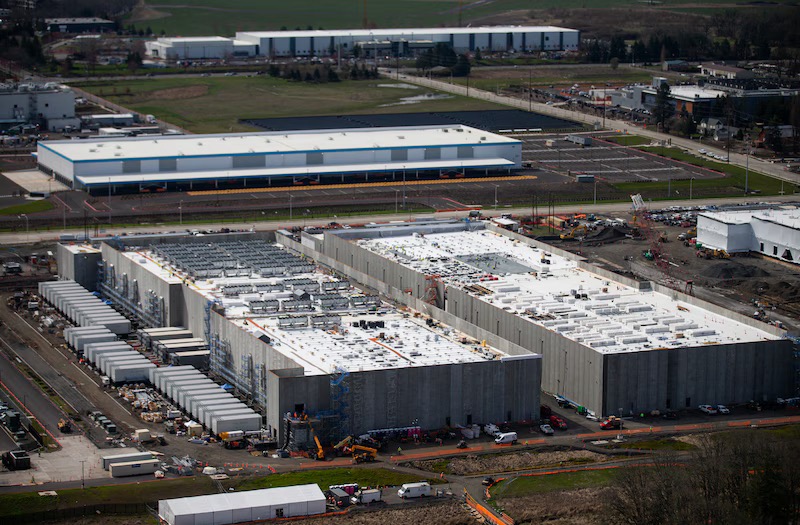
A coordinated barrage of Iranian missiles and drones has struck critical cloud infrastructure in the Gulf, severely damaging data centers operated by Amazon Web Services (AWS) in Bahrain and Dubai. The unprecedented attack has forced the company to declare a “hard down” status across multiple availability zones, disrupting digital services for businesses and governments across the Middle East and beyond.
According to preliminary reports, the strikes targeted key facilities in Bahrain’s primary AWS region and the Dubai-based zone that serves as a major digital hub for the United Arab Emirates. The assault forms part of a broader escalation involving Iran and U.S.-aligned Gulf states, with advanced infrastructure increasingly drawn into the conflict.
AWS engineers confirmed internally that several availability zones—clusters of data centers designed to provide redundancy and resilience—have gone completely offline. In cloud computing terminology, a “hard down” status signifies total service failure, meaning systems cannot be accessed or restored remotely. This differs from partial outages, where services may be degraded but still functional.
The outages have had immediate and far-reaching consequences. Businesses relying on AWS for hosting, storage, and computing power reported widespread service interruptions, including failures in banking systems, e-commerce platforms, airline booking services, and government portals. Several fintech companies operating in Bahrain and Dubai were among the hardest hit, with transaction systems grinding to a halt within minutes of the strikes.
Experts say the incident marks a turning point in modern warfare, where digital infrastructure is no longer collateral damage but a deliberate target. Data centers, often described as the “backbone of the internet,” house vast quantities of information and power the applications that underpin daily life. Disabling them can paralyze entire economies without a single shot being fired on traditional battlefields.
The attack also highlights the vulnerability of centralized cloud systems. Although providers like AWS design their networks with redundancy in mind—spreading workloads across multiple regions—the concentration of services in specific geographic hubs can create critical points of failure. In this case, the Middle East regions of AWS play a crucial role in serving customers across the Gulf, North Africa, and parts of South Asia.

In response, AWS has initiated emergency protocols to shift workloads to unaffected regions in Europe and Asia. However, such migrations are neither instantaneous nor seamless. Many applications are configured to operate within specific regions due to latency requirements, data sovereignty laws, or architectural limitations. As a result, customers have experienced prolonged downtime despite the company’s efforts to reroute traffic.
The parent company, Amazon, has yet to issue a detailed public statement, but insiders indicate that damage assessments are ongoing and that recovery could take days or even weeks depending on the extent of physical destruction. Rebuilding or repairing data center infrastructure is a complex process involving hardware replacement, network reconfiguration, and rigorous safety checks.
The strikes have also reignited debate over the militarization of cyberspace and digital assets. While cyberattacks have long been part of geopolitical conflicts, the physical targeting of cloud infrastructure represents a new and more dangerous escalation. Analysts warn that such actions could set a precedent, making data centers, undersea cables, and satellite networks legitimate targets in future conflicts.
Governments across the region have begun assessing the impact on national infrastructure. In the United Arab Emiratesand Bahrain, authorities are working with private sector partners to restore essential services and ensure continuity in critical sectors such as healthcare, finance, and transportation.
Meanwhile, cybersecurity and cloud resilience experts are urging organizations to rethink their dependence on single providers or regions. Multi-cloud strategies—where businesses distribute workloads across different cloud vendors—and hybrid systems that combine cloud and on-premises infrastructure are gaining renewed attention as safeguards against such disruptions.
The broader geopolitical implications are equally significant. By targeting infrastructure linked to a major U.S. technology company, Iran has signaled its willingness to expand the battlefield beyond traditional military targets. This raises concerns about potential retaliatory actions and further escalation involving global tech giants.
For ordinary users, the incident serves as a stark reminder of how deeply embedded cloud services are in everyday life. From streaming platforms and online banking to ride-hailing apps and government services, much of the modern digital ecosystem depends on the seamless functioning of data centers.
As recovery efforts continue, the full extent of the damage—and its long-term consequences—remains uncertain. What is clear, however, is that the line between physical and digital warfare has blurred. In an increasingly interconnected world, the destruction of servers and data hubs can be as disruptive as the loss of roads, ports, or power plants.
The AWS outage in Bahrain and Dubai may ultimately be remembered as a watershed moment—one that forces governments, corporations, and users alike to confront a new reality: in the age of cloud computing, the battlefield is no longer confined to land, sea, or air, but extends into the very infrastructure that powers the global internet.