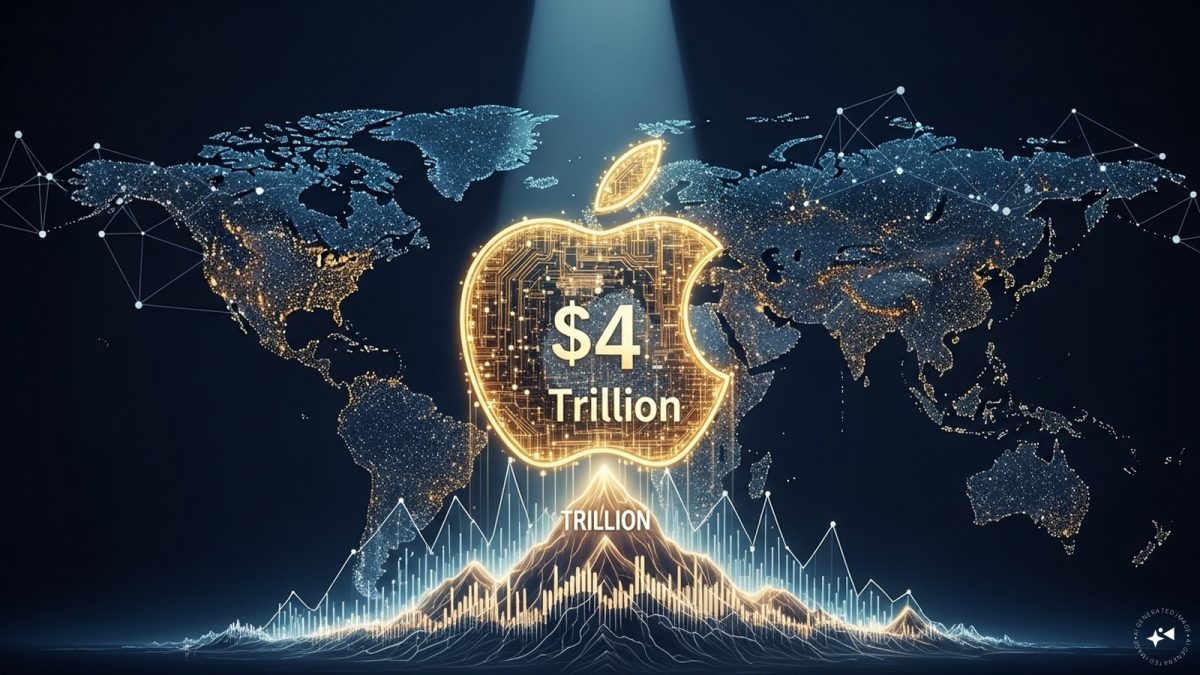
Apple has once again rewritten history. On Tuesday, the world’s most valuable company became the first ever to surpass a $4 trillion market capitalization, fueled by surging investor optimism and a stunning rebound in iPhone sales. The milestone caps a remarkable year for the Cupertino-based giant, which has regained its growth momentum after a period of slowing demand and growing regulatory pressures.
A Record-Breaking Moment
Apple’s shares jumped nearly five percent in Tuesday’s trading, pushing the company’s valuation just over the $4 trillion threshold—a feat that cements its dominance not just in technology, but in global markets overall. It marks a major psychological and financial milestone, coming roughly three years after Apple first crossed the $3 trillion barrier in 2022.
Chief Executive Officer Tim Cook called the moment “a reflection of our enduring commitment to innovation, customer trust, and the seamless integration of technology into people’s lives.” For investors, it signals renewed confidence that Apple’s growth story—driven by its combination of cutting-edge hardware and high-margin services—still has plenty of room to run.

The iPhone Strikes Back
At the heart of Apple’s resurgence is the iPhone 16 lineup, which has reignited consumer excitement in a smartphone market that many had declared saturated. The new iPhone 16 Pro and Pro Max models feature Apple’s advanced A19 Bionic chip, expanded battery life, and enhanced camera systems powered by on-device artificial intelligence.
These AI capabilities, branded under Apple’s new “Apple Intelligence” framework, enable features like real-time language translation, predictive photo editing, and personalized app experiences—all processed privately on the device rather than in the cloud. This approach has resonated strongly with consumers increasingly wary of data privacy concerns.
Early indicators suggest double-digit year-over-year growth in iPhone sales, particularly in key markets such as China, India, and the United States. Analysts attribute the rebound to both technological appeal and Apple’s strategic focus on trade-in programs and subscription plans that make premium upgrades more affordable.
“The iPhone 16 has done what few expected—it made people excited to buy new phones again,” said one analyst. “Apple’s focus on privacy, design, and seamless intelligence has put it far ahead of its rivals.”
Services and Wearables Powering the Engine
While the iPhone remains Apple’s flagship product, the company’s Services division continues to be its most reliable growth engine. Revenue from subscriptions—including Apple Music, iCloud, Apple TV+, Apple Arcade, and the all-encompassing Apple One—hit record levels this quarter. With hundreds of millions of paid subscribers globally, Apple’s services now deliver consistent, recurring revenue that cushions the cyclical nature of hardware sales.
Meanwhile, Apple’s Wearables and Vision category—led by the Apple Watch Series 10 and the Vision Pro 2 headset—has become the company’s next growth frontier. The latest Apple Watch has drawn attention for its expanded health-tracking features, while the Vision Pro 2, with its lighter design and growing library of spatial-computing apps, is finding traction in creative and enterprise markets.
This diversification has made Apple less vulnerable to fluctuations in any single product line. As a result, Wall Street now sees the company not just as a hardware innovator, but as a comprehensive technology ecosystem spanning devices, software, and digital services.
A Rebound in Confidence
Apple’s march to $4 trillion also reflects a broader recovery in investor sentiment after a turbulent 2024. The company faced headwinds from slowing smartphone demand, geopolitical tensions, and antitrust scrutiny in both the U.S. and Europe. But 2025 has brought a series of strong quarters marked by improving margins, supply chain efficiency, and renewed product momentum.
Apple’s return to double-digit revenue growth, combined with robust free cash flow, has reassured investors that the company’s best days are not behind it. The successful rollout of the iPhone 16, alongside the steady performance of Macs and iPads powered by the company’s M4 Ultra chip, has reinforced the view that Apple’s vertical integration—designing its own silicon, software, and services—continues to deliver a sustainable competitive edge.
The Strength of the Ecosystem
A key driver behind Apple’s enduring dominance is its unmatched ecosystem. The company now boasts over 2.4 billion active devices globally, creating a vast network of interconnected users across iPhone, iPad, Mac, Watch, and Vision products. Each new product seamlessly integrates into this ecosystem, deepening customer loyalty and creating cross-selling opportunities across services and accessories.
This interconnectivity has turned Apple products into more than devices—they’re entry points into a lifestyle. The average Apple user today subscribes to multiple services, owns more than one Apple device, and interacts with the brand daily. That stickiness translates into predictable revenue streams and exceptional customer retention rates that few competitors can match.
)
Challenges on the Horizon
Despite the record valuation, Apple faces challenges that could test its resilience. Regulators continue to scrutinize its App Store policies and default-app settings, particularly in the European Union, where new digital competition laws are forcing changes to long-standing practices.
At the same time, competitors such as Google, Samsung, and Huawei are investing heavily in their own AI-integrated smartphones, while emerging markets are being flooded with affordable alternatives from local brands. Maintaining growth in this landscape will require Apple to balance innovation with accessibility—continuing to deliver breakthrough features without alienating price-sensitive customers.
There’s also pressure from investors for Apple to pioneer its next major product category. Rumors of an Apple-designed electric vehicle have cooled, shifting focus to augmented and virtual reality, health technology, and AI-driven software platforms as the company’s next frontiers.
A Symbolic and Strategic Triumph
Crossing the $4 trillion mark is more than a financial achievement; it’s a statement about Apple’s staying power in a fast-changing world. The company has navigated decades of technological upheaval—from the dawn of personal computing to the rise of mobile and now AI—while maintaining an unmatched level of trust, polish, and profitability.
Apple’s formula remains simple but potent: build great products, ensure they work together beautifully, and guard user privacy as a competitive advantage. That approach has created not just loyal customers, but an ecosystem that powers one of the most successful business models in history.
The Road Ahead
As Apple looks to 2026 and beyond, it faces the dual challenge of sustaining growth while leading responsibly in an AI-driven future. With its financial strength, loyal user base, and unmatched integration of hardware and software, the company is well-positioned to shape the next era of personal technology.
For now, the $4 trillion milestone stands as a defining chapter in Apple’s story—a testament to innovation, discipline, and an almost unmatched ability to turn technology into cultural magic.